eSIM vs Roaming: What International Roaming Really Costs
2026-07-16
An eSIM is almost always cheaper than international roaming. Typical carrier roaming day passes cost $10-15 per day and pay-per-use rates run $2-12 per MB, so a 10-day trip can easily reach $100-150. A travel eSIM covering the same trip starts at $2 for a single country, or $40 for 10 days of unlimited data across 101 countries.
What carriers actually charge for international roaming
Carrier roaming comes in two flavors, and both are priced for convenience, not value. The first is the daily pass: at typical carrier rates you pay $10-15 per day to use your domestic plan abroad, and the charge usually triggers the moment your phone touches a foreign network — even for a background app refresh. Over a two-week trip that is $140-210 before you have sent a single photo. The second flavor is pay-per-use, the default if you never opted into a pass: typical rates run $2-12 per megabyte. At those prices, one minute of video calling or a single map reload can cost more than an entire travel eSIM plan. Carriers also bill day passes per line, so a couple traveling together pays twice. None of this reflects the real cost of data abroad; it reflects the fact that roaming customers rarely shop around.
What a travel eSIM costs instead
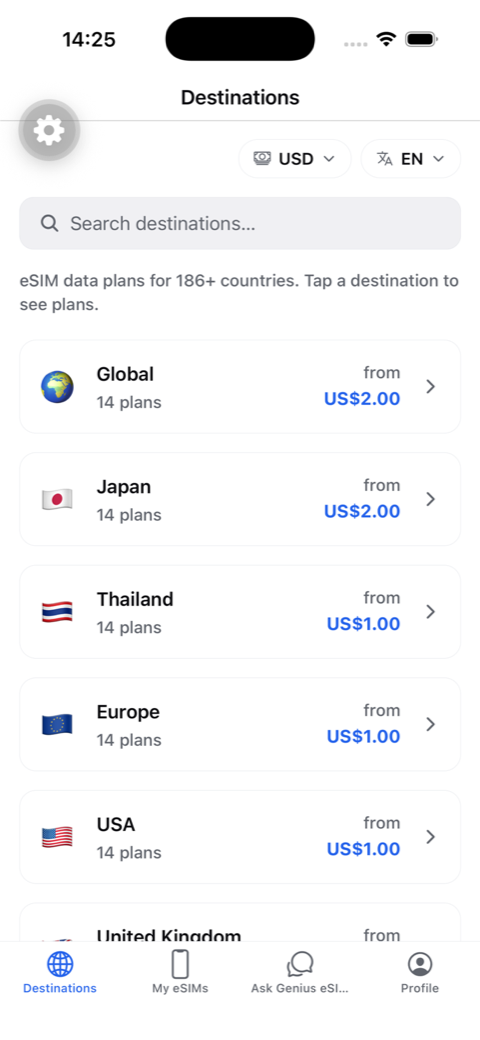
A travel eSIM is a second, data-only line you install before you fly — no store visit, no physical SIM swap. At esimgenius, single-country plans across 187 destinations start at $2, delivered as an instant QR code you scan once. If your trip spans many countries, the Global plan covers 101 of them with fully unlimited data — no throttling: 3 days for $12, 5 for $19, 7 for $27, 10 for $40, 15 for $52, or 30 for $89. Frequent flyers can skip buying per trip entirely with Global Monthly: $38.90/month for 30 GB at full speed then unlimited at 2 Mbps (never cut off), or $54.90/month unlimited — 38% less than the $89 prepaid 30-day pass — on the same eSIM every month, cancel anytime online. Every plan allows hotspot use, and you can top up anytime without scanning a new QR.
The math: a 10-day trip, roaming vs eSIM
Run the numbers for a 10-day trip. Roaming with a typical $10-15 daily pass: 10 days × $10-15 = $100-150 per line. Roaming pay-per-use at typical $2-12/MB rates: even a frugal 100 MB per day is 1 GB total, or $2,000-12,000 — which is why nobody sane roams without a pass. Now the eSIM side: a 10-day unlimited Global eSIM is $40 flat, a saving of $60-112 versus the day pass. Staying in one country? A single-destination plan for Japan or Europe starts at just a few dollars, pushing the saving past $90. Two travelers double every number: $200-300 in roaming passes versus $80 in eSIMs. The pattern holds at any trip length — roaming scales linearly at $10-15 per day forever, while eSIM pricing flattens the longer you stay.
When carrier roaming is actually fine
Roaming is not always the wrong call. If your trip is a single day — a border hop or a long layover — one $10-15 day pass is simple and the savings from an eSIM are small. If your domestic plan genuinely includes free roaming in your destination (some plans include Canada or Mexico at no extra cost, for example), use it. And if you absolutely must receive calls and SMS on your primary number the entire trip and your phone supports only one active line, roaming keeps everything on one SIM. That last case is rarer than people think: every eSIM-capable phone sold in recent years runs two lines at once, so you can keep your home SIM active for calls and texts while all data flows through the cheaper eSIM. For any data use beyond a day or two, the math favors the eSIM.
When an eSIM clearly wins
The eSIM wins in every scenario where data matters and the trip lasts more than a couple of days. Multi-country itineraries are the clearest case: one Global eSIM covers 101 countries, while day passes re-trigger in each new country and per-country local SIMs mean queueing at airport kiosks. Heavy data users — maps, translation, video calls, hotspotting a laptop — win because the unlimited plans are fully unlimited data with no throttling. Families and couples win because each additional eSIM costs a few dollars instead of another $10-15/day pass. And anyone who has been bill-shocked wins on predictability: you pay upfront, the price is the price, and esimgenius refunds you if the eSIM can't be installed. Travelers rate the experience 4.8/5 on Trustpilot. Setup takes about two minutes: buy, scan the QR, land, connect.
How to avoid roaming fees on your next trip
Three steps kill roaming charges completely. First, before you fly, buy an eSIM for your destination and install it on Wi-Fi at home — pick your country from the destinations list, or grab a Global plan for multi-stop trips. Second, in your phone's settings, set mobile data to the eSIM and turn data roaming OFF for your home SIM; leave the home SIM enabled so calls and texts still reach your number, since the eSIM is data-only and your number stays exactly where it is. Third, decline your carrier's day-pass enrollment if it is opt-out rather than opt-in — otherwise one stray background ping abroad can trigger a $10-15 daily charge even while the eSIM handles your actual data. That is the whole playbook: about $2-40 spent deliberately instead of $100-150 billed automatically, with the same phone, the same number, and better coverage flexibility.
FAQ
Is an eSIM cheaper than international roaming?
Yes, in almost every case. Typical carrier roaming day passes cost $10-15 per day, so a 10-day trip runs $100-150, while a 10-day unlimited eSIM covering 101 countries costs $40 and single-country plans start at $2. The gap widens with trip length and with each extra traveler.
How much does roaming cost per day?
Typical carrier day passes run $10-15 per day per line, charged automatically each day your phone uses a foreign network. Without a pass, pay-per-use roaming at typical rates of $2-12 per MB can turn 1 GB of data into a four-figure bill.
Do I lose my phone number if I use a travel eSIM?
No. A travel eSIM is data-only and runs alongside your regular SIM, so your number stays active for calls and SMS. Just switch mobile data to the eSIM and turn roaming off on your home line to avoid charges.
When is it better to just use roaming?
Roaming makes sense for a one-day trip or layover, when your plan genuinely includes free roaming in your destination, or on the rare phone that can't run two lines at once. For any data use beyond a day or two, an eSIM is meaningfully cheaper.
What happens if the eSIM doesn't work on my phone?
esimgenius refunds you if the eSIM can't be installed. Activation is an instant QR code, and you can top up an existing eSIM anytime without scanning a new one — so there's no risk in setting it up before you fly.